“On the internet, nobody knows you’re a dog.” That’s a famous adage and cartoon from “The new Yorker”, which means our online and offline identities can be totally different.
What is online identity?
Online identity can be anything from your internet, any social media account you have. Some people choose to use their real names online, some prefer to use anonymous or pseudonyms, which show different amounts of personally identifiable information. An online identity can even be determined by the social network to which the user belongs. Some users can even provide false information.
Is online identity being same with real life?
Online identity is like a mask which can cover who you are, what’s your job, where are you come from… In the network society, we put on a mask and become brave, just like when you go on stage, people always tell you to ignore the audience and ignore them.

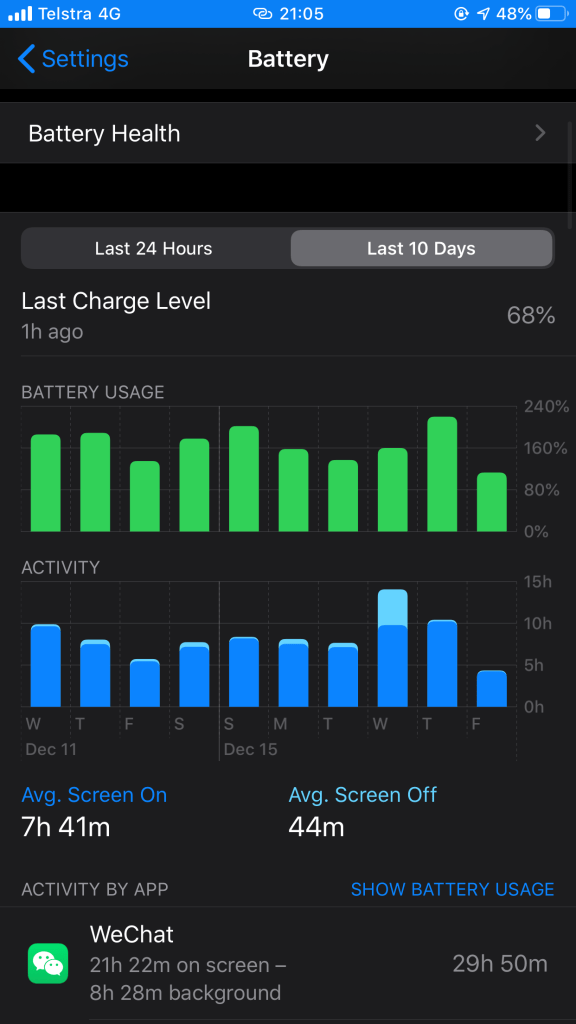
As the Internet becomes a bigger part of our lives, we spend more and more time online. According to Roy Morgan(2018), there are 20.2 million Australians aged 14+, who each had 8,760 hours to spend over the last 12 months in 2018. That’s sound incredible, but that’s the truth, if you check your phone usage now, you’ll be even more surprised.
(As I wrote this, I also checked my phone usage time, i spend seven hours a day on my phone? why i spend 29h50m on WeChat??😱)
picture from nicole, 18 December 2019
We spend so much time to build our online identity, we can choose who we are, maybe a “bad” student is a famous YouTuber, a normal marketing officer can be a music blogger, a tattoo artist can also be a novelist… that’s sound really interesting isn’t it? 😊
My experience
From middle school, I began to use Weibo (like Chinese Facebook) rather than WeChat or some famous Chinese social media. The reason at the begging that I choose to use Weibo is I think that’s a place where I could share some aspects of my life without being discovered by my family members and friends.
However, as it’s getting more and more popular, many of my friends started using it even my sister. One day, my sister told me “I found you Weibo account and follow you!” wow, I just felt very embarrassed and nervous. 😅 That’s because I didn’t want to show her this side of me, you know there always have something you don’t want to talk with your family members. At that moment I thought “okay, it’s time to say goodbye with my secret garden. 💔
Back to today, because of I came to Melbourne to study, in order to better integrate into the local society, I started using Twitter, Facebook and Instagram. More importantly, I started building my online identity again. I think it is really important because that’s the most direct way for my foreign friends to know me. So, I always put some pictures and ideas about my own life to share with them. Besides, I found this a good channel to show our Chinese culture. Every time I go back to China, I will take some photos and upload them.
Protect your online identity
At this internet age, it is not only important to make our online identity, moreover, we need to pay more attention about our online privacy. According to Youn Seounmi(2009), More and more teenagers are also aware of the importance of protecting online privacy. That’s a really good thing for us, If people are aware of this from an early age, there will be less leakage of network information.
Identity theft:

Identity theft means deliberate use someone’s personal data or identity to obtain some financial advantage, credit or other advantage in the person’s name. that’s usually because we always put our important personal information like name, address, credit card number, etc. available online.
How can we protect our identity theft?
I have searched some tips for yours:
- Use strong passwords — never use simple passwords like 123456789 or your name and birthday; besides, do not use same passwords everywhere, that’s the dream of thieves.
- Update your security software — make sure your phone and computers have a latest software.
- Beware of public WIFI — I know that we all love using WIFI at some public area, however, there may have some virus and thieves behind the free WIFI. Make sure do not use public WIFI to do some financial transactions or enter any sensitive information.
- Check bank statements regularly— make sure there didn’t have any unusual transactions on your account. Criminals usually steal a small amount of money at first and empty your account if they are not caught.
In short, do you know anything about online identity now? Do you understand the importance of network security? I hope this blog can give you some help or ideas. Again, “On the internet, nobody knows you’re a dog.” So, who you are behind the mask of online identity? 💗
Reference list:
Fay B n.d, what is identity theft?, Debt, retrieved in 19 December 2019.< https://www.debt.org/credit/identity-theft/>
Morgan R 2018, Australians spending more time online than working, Roy Morgan, retrieved in 18 December 2019.< http://www.roymorgan.com/findings/7665-time-spent-working-and-media-march-2018-201807200811>
Strawbridge G 2018, How to Protect your Online Identity, Cyberradio, retrieved in 17 December 2019.< https://www.cyberradio.com/2018/07/how-to-protect-your-online-identity/>
Youn S 2009, Determinants of online privacy concern and its influence on privacy protection behaviors among young adolescents. Journal of Consumer affairs, 43(3), 389-418.
 My story behind pictures.